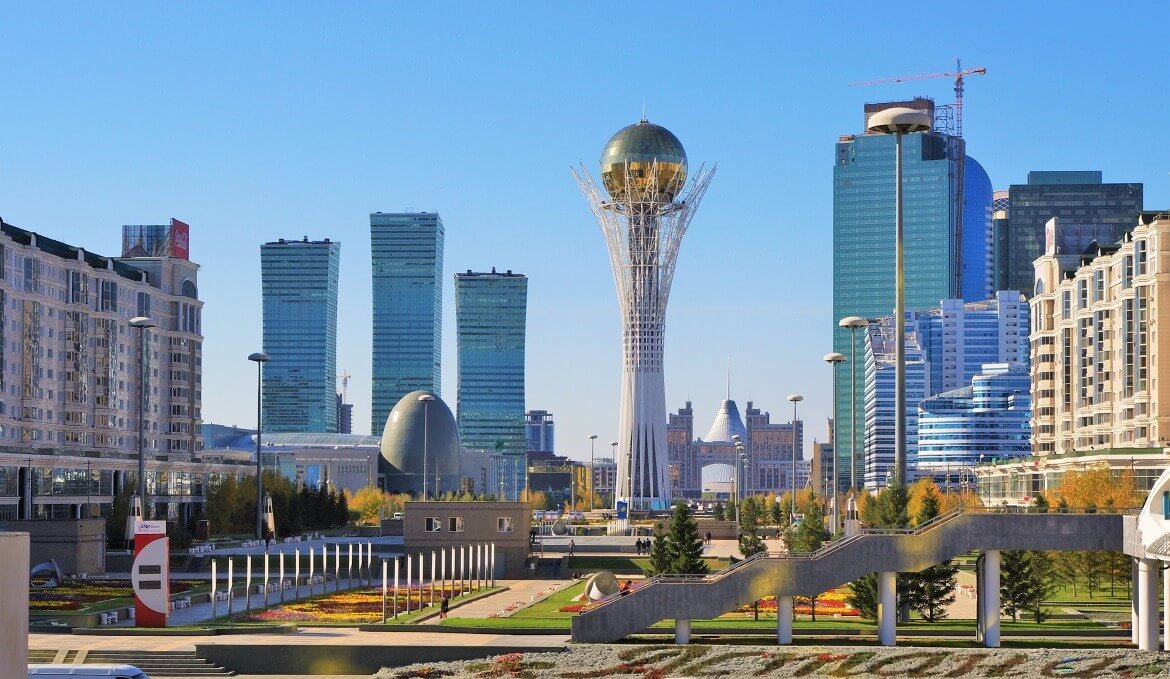
Seven years after Kassym-Jomart Tokayev assumed Kazakhstan’s presidency, a striking set of economic and social indicators offers a statistical portrait of a country that has become considerably larger economically, accumulated greater financial reserves and invested heavily in industry, schools and a new generation of Kazakh citizens.
When Kassym-Jomart Tokayev took the presidential oath on 20 March 2019, Kazakhstan was entering a new political era after almost three decades under its first president, Nursultan Nazarbayev. Tokayev subsequently won the presidential election in June 2019 and was re-elected in November 2022. (Akorda.kz)
Seven years later, one way of examining what has happened to Central Asia’s largest economy is not through speeches or political slogans, but through the numbers.
And those numbers tell a story of substantial change.
According to figures compiled to mark the seven-year period, Kazakhstan’s annual gross domestic product has increased from $181.7 billion to approximately $305.9 billion, while GDP per capita has risen from around $9,800 to $15,000.
That latest GDP figure is independently reflected in Kazakhstan’s official statistics. The Bureau of National Statistics puts 2025 GDP at $305.956 billion, calculated at the National Bank’s average exchange rate, with GDP per head at $15,005.4. Real economic growth during the year was reported at 6.5%. (National Statistics Bureau of Kazakhstan)
For a country of Kazakhstan’s size, geography and dependence on commodities, the composition of that growth is as significant as its scale.
Manufacturing moves up the economic agenda
One of the more revealing figures concerns manufacturing.
The seven-year briefing puts manufacturing output at approximately KZT30.6 trillion in 2025, compared with KZT11.5 trillion at the earlier point cited in the document.
Official 2025 statistics similarly record manufacturing production of around KZT30.7 trillion, accounting for almost half of Kazakhstan’s total industrial production. Manufacturing output grew by 7.1% in the year, according to the country’s statistics bureau. (National Statistics Bureau of Kazakhstan)
That matters because diversification has long been one of Kazakhstan’s central economic challenges.
Oil, gas and mineral resources remain enormously important, but successive governments have sought to build a broader productive economy capable of generating employment and exports outside the extractive industries.
The latest numbers suggest that manufacturing is increasingly substantial in its own right.
Investment has also risen sharply. The briefing records fixed-capital investment increasing from KZT12.6 trillion to KZT22.7 trillion over the period.
Meanwhile, 540 industrial projects implemented between 2023 and 2025 are credited in the document with creating more than 50,000 jobs, representing total project value of approximately KZT1.076 trillion.
Those numbers do not by themselves demonstrate how evenly the benefits have been distributed across Kazakhstan’s regions or households. Nor can every change in a national economy simply be attributed to a president: commodity prices, exchange rates, international investment, global growth and the disruption of the COVID-19 pandemic have all influenced Kazakhstan’s economic trajectory since 2019.
But they do illustrate the scale of economic activity that has taken place during the period.
A much larger financial cushion
Perhaps less visible to the ordinary consumer, but important for Kazakhstan’s resilience, has been the movement in the country’s external financial position.
The seven-year comparison shows net external debt declining from approximately $51.0 billion in the first quarter of 2019 to $35.1 billion in the first quarter of 2026.
Over the same Q1-to-Q1 comparison, gross international reserves are reported as having risen from approximately $27.0 billion to $66.8 billion, while the monetary-gold component of reserves increased from around $15.0 billion to $51.8 billion.
These are perhaps among the least dramatic statistics politically, but among the more consequential economically.
Foreign reserves provide governments and central banks with protection against external shocks and currency pressures — a particularly relevant consideration for an open economy located between Russia and China and closely connected to international energy and commodity markets.
From national wealth to children’s accounts
The most unusual policy development of the period may be one whose full consequences will not become apparent for many years.
Kazakhstan’s National Fund for Children programme began on 1 January 2024.
Under the scheme, 50% of the National Fund’s annual investment income is allocated equally among Kazakhstan’s citizens under the age of 18, with the accumulated funds becoming available when they reach adulthood for purposes including education and housing. (Government of Kazakhstan)
By the end of 2025, the programme covered 6,918,656 children, each receiving a further annual allocation of $130.71. (Government of Kazakhstan)
By 2026, official government reporting said roughly 6.91 million children were participating and that around $2.3 billion had been distributed over the programme’s first three years. (Government of Kazakhstan)
The sums held by an individual child remain relatively modest, but the principle is noteworthy: part of the investment return from Kazakhstan’s sovereign wealth is being converted into an individual financial asset for almost an entire generation.
It creates a direct connection between the country’s accumulated national wealth and its younger citizens — an experiment that will increasingly be judged by how those funds are ultimately used for education and housing.
The school-building drive
Education infrastructure provides another visible measure of state investment.
The briefing states that more than 1,300 schools have been built since 2019.
Recent official Ministry of Education figures use somewhat different time periods: government data published in 2026 say 1,120 schools were built over the preceding five years, while another government account reports more than 1,200 new schools since 2019, providing places for more than one million pupils. (Government of Kazakhstan)
The broader trend is nevertheless clear.
Kazakhstan is dealing with the consequences of a young and growing population and significant internal migration towards its largest cities. In 2025 alone, 162 schools providing nearly 236,000 pupil places were completed; over the previous three years, 584 schools providing 746,000 places entered service. (Government of Kazakhstan)
The government is simultaneously pursuing a programme to renovate hundreds of existing schools.
Recovered money returned to public projects
Another figure in the seven-year assessment carries a different political significance.
It records 434 social and infrastructure projects financed using recovered assets.
Kazakhstan has placed the recovery of assets judged to have been unlawfully removed from the country or accumulated through improper means within its wider governance agenda.
The significance of the programme will ultimately depend not simply on how much money is recovered, but on whether citizens can see recovered assets being converted transparently into schools, hospitals, utilities and other public infrastructure.
That makes the number of completed projects potentially as important politically as the headline monetary sums.
Seven turbulent years
Statistics inevitably flatten history.
The period beginning in 2019 encompassed a global pandemic, the January 2022 unrest inside Kazakhstan, Russia’s full-scale invasion of Ukraine and the resulting disruption to regional trade routes, inflationary pressures and profound geopolitical changes across Eurasia.
It also coincided with significant constitutional and institutional reforms.
Tokayev has characterised the programme as the construction of a “Just Kazakhstan”. Constitutional changes included the introduction of a single seven-year presidential term, while the authorities have pursued changes to the country’s political and economic institutions. (Akorda.kz)
Debate will continue over the depth, pace and consequences of those political reforms.
The economic numbers answer a narrower question.
They show that the Kazakhstan of 2026 is economically larger than the Kazakhstan Tokayev inherited in 2019; manufacturing has expanded, investment has increased, international reserves are substantially higher on the comparison presented, and billions of dollars in sovereign wealth are now being shared through a programme covering almost seven million children.
The figures cannot establish how much of that change resulted directly from presidential policy, nor can national aggregates alone measure living standards, inequality or public satisfaction.
But seven years into the Tokayev presidency, they provide something useful: a measurable snapshot of how far Kazakhstan has moved — and a benchmark against which the next phase of the country’s development can be judged.