Talks in Brussels have put the delivery of commercial and research agreements at the centre of a growing partnership, with implications for Europe’s transport connections and access to critical raw materials.
Kazakhstan and Belgium are moving to turn a year of intensive diplomacy into closer economic cooperation, with investment, transport and critical minerals leading the agenda after October’s first Belgian state visit to Kazakhstan.
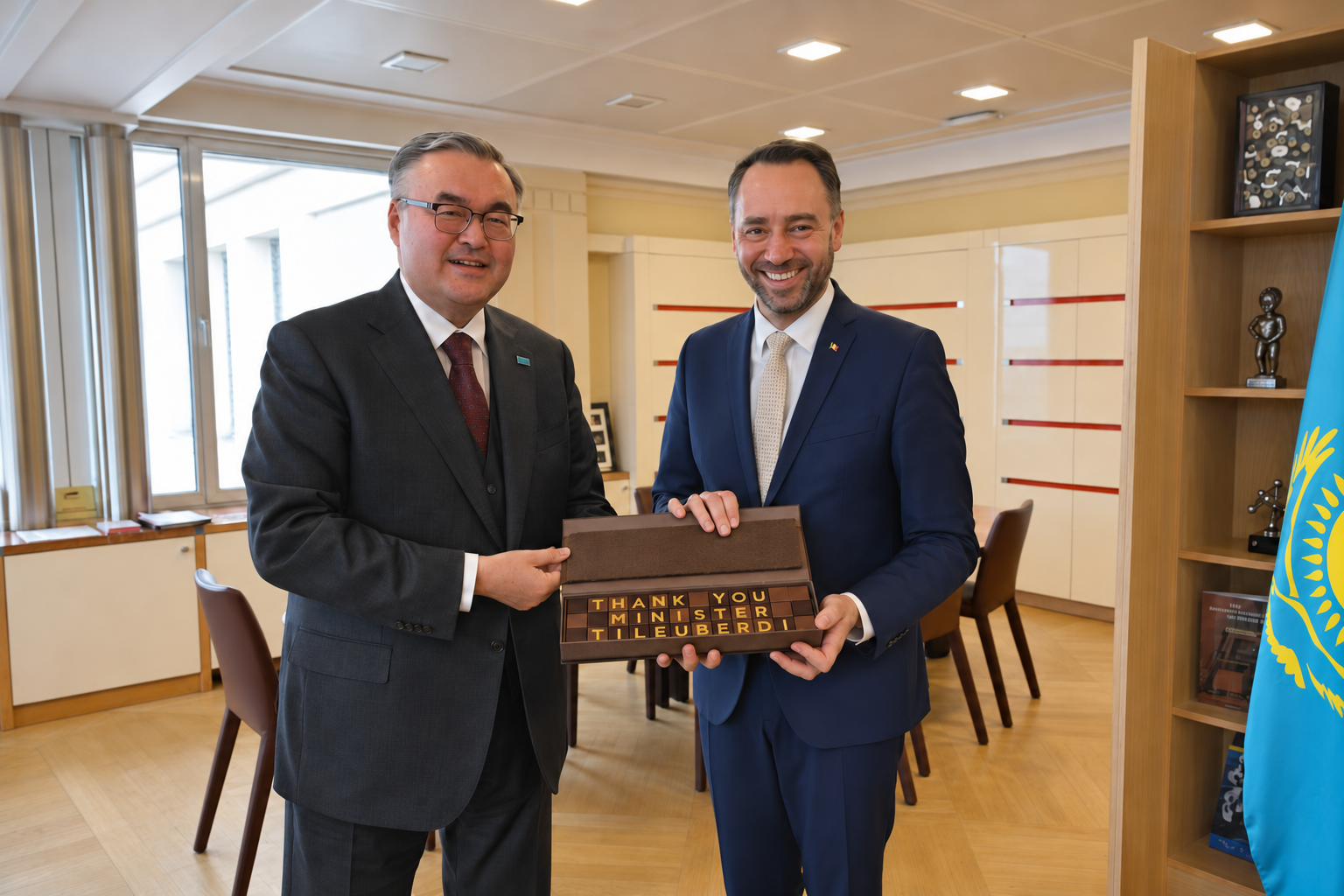
Kazakh Foreign Minister Mukhtar Tileuberdi (pictured) met Belgium’s Deputy Prime Minister and Foreign Minister Maxime Prévot in Brussels (pictured) on 17 November to discuss how to implement agreements reached during President Kassym-Jomart Tokayev’s visit to Belgium in June and the subsequent visit of King Philippe and Queen Mathilde to Kazakhstan.

The royal visit, which took place on 11–14 October, gave the relationship greater political visibility. The latest ministerial talks bring the focus to what governments, companies and universities can deliver in its wake.
Turning agreements into projects
According to Kazakhstan’s embassy in Brussels, 40 documents were announced during the royal visit, including 16 commercial agreements and 22 agreements between universities and research institutions. A cooperation roadmap signed by the two foreign ministries covers 2027–2029, providing for regular consultations and closer coordination.
The scale of that programme suggests a relationship expanding across several parts of the economy. Its success will depend on how many agreements secure funding, establish lasting partnerships and produce services or products that people can use.
There is already a substantial commercial base. Belgium’s foreign ministry reported that bilateral trade reached €765 million in 2025, compared with €220 million in 2016, and that more than 100 Belgian companies were operating in Kazakhstan, including in chemicals, biopharmaceuticals and energy.
For EU policymakers, the bilateral relationship also sits within a much larger trading partnership. European Commission figures put EU–Kazakhstan trade in goods at €41.4 billion in 2025. Fuel and mining products accounted for 92% of Kazakhstan’s goods exports to the EU, showing how heavily that relationship still depends on resources.
That concentration helps explain the importance of cooperation in processing, technology and research. Such projects could give Kazakhstan more opportunities to develop industries around its resources, while offering European businesses a broader range of commercial partners.
Transport gives the partnership a practical focus
The Trans-Caspian International Transport Route, widely known as the Middle Corridor, is central to the discussions. Both governments have identified its development as a priority for improving transport connections between Asia and Europe.
Separate meetings with Belgian business leaders during Tileuberdi’s Brussels visit illustrated the work involved. On 16 November, the Kazakh foreign ministry reported talks with Sarens Group representatives about a proposed $50 million transport and logistics hub in the Zhetysu region.

Plans include storage facilities, a bypass road and infrastructure for heavy cargo, intended to ease bottlenecks at the Nur Zholy border crossing. Discussions with Ahlers Logistics and BIM e-Solutions also covered a possible 90-day digital pilot to track freight, exchange customs information and reduce delays along the Middle Corridor.
These remain proposals and initiatives under discussion. They nevertheless identify practical problems that investment could address: a route’s commercial appeal depends on how reliably goods move through warehouses and border crossings, as well as on the infrastructure connecting them.
European financing is already supporting the wider transport agenda. The European Investment Bank says it signed a €150 million framework loan in June 2026 with Kazakhstan’s national road operator, QazAvtoZhol, for a programme covering approximately 1,370 kilometres of strategic roads. The bank also emphasises efficient border procedures and reliable connections between road and rail as conditions for the corridor’s economic impact.
Critical minerals and knowledge partnerships
Critical raw materials provide another clear area of shared interest. Belgium’s foreign ministry has highlighted the potential to combine Kazakhstan’s mineral resources with Belgian expertise in processing and recycling.
That cooperation fits an existing European framework. The EU and Kazakhstan endorsed a 2025–2026 roadmap on raw materials, batteries and renewable hydrogen at the first EU–Central Asia summit in April 2025. Its priorities include geological exploration, research, training and environmental and social standards.
The opportunity is to develop commercially viable projects across extraction, processing and recovery. For Kazakhstan, local processing could support skilled employment and retain more economic value. For Europe, additional suppliers and processing partners could help diversify industrial supply chains. Those gains will depend on the terms and performance of individual projects.
Education and research could help sustain this cooperation. The October joint statement supported academic exchanges, joint educational programmes and partnerships between research institutions. It also identified artificial intelligence, big data and computing infrastructure as areas for further collaboration.
The 22 academic agreements announced during the visit give those ambitions a starting point. Their longer-term value will be measured through student exchanges, research activity and the development of expertise that can support both countries’ industries.
A test of delivery
The political dialogue is set to continue. According to the Kazakh foreign ministry’s account of the Brussels meeting, Prévot confirmed his intention to visit Kazakhstan in 2027 as part of a wider Central Asian tour. The two countries will also mark 35 years of diplomatic relations next year.
That anniversary provides a useful point at which to assess progress. For businesses, researchers and transport operators, the most meaningful outcomes will be funded projects, functioning partnerships and fewer obstacles to cooperation. The Brussels talks have established delivery as the next measure of the relationship.