




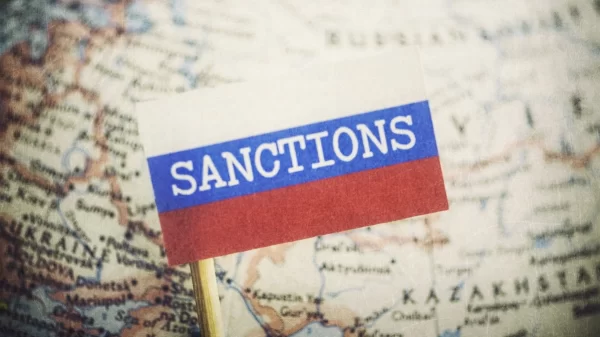


Russia has banned 81 EU-based media outlets, claiming they “systematically disseminate false information about the progress of a special military operation [Russia’s invasion of Ukraine].”.
The Russian foreign ministry announced the decision on Tuesday (June 25)) in response to EU restrictions placed on Russian propaganda outlets.
Russia’s online ban extends to national broadcasters and news organisations in Austria, the Czech Republic, Estonia, Greece, Finland, France, Ireland, Italy, Latvia, Lithuania, Malta, the Netherlands, Portugal, Spain, and Sweden, but not Germany or Poland.
Also banned by the Kremlin are several of Europe’s most well-known newspapers, including Berlingske in Denmark, France’s Le Monde and Liberation, Germany’s FAZ, Der Spiegel, and Die Zeit, the Irish Times, La Repubblica in Italy, NRC in the Netherlands, and El Pais in Spain.
Four EU-focused media, Agence Europe, Politico and EUObserver in Brussels and RFE/RL in Prague, are included in the ban.
Moscow did not identify other EU-focused media outlets, such as EU Reporter, Euractiv, or Euronews.
The Russian government also spared all pro-Russian media in Hungary, with the exception of one independent outlet, 444.hu.
The ministry described the action as a “mirrored and proportionate” reaction to EU measures against Russian media.
“If restrictions on Russian media are lifted, the Russian side will also reconsider its decision in relation to the mentioned media operators,” the Russian Embassy stated.
On Monday, the EU blacklisted four Russian propaganda channels: Voice of Europe, RIA Novosti, Izvestia, and Rossiyskaya Gazeta.
In a recent investigation by Belgian, Czech, and Polish intelligence, the Voice of Europe, based in Prague, was accused of bribing MEPs to act for Russia. This is still being investigated.
Previously, the EU prohibited Russian stations Katehon, Pervyi Kanal, REN TV, Rossiya 1, Rossiya 24, Spas TV, Sputnik, Russia Today, Tsargrad TV, and numerous of their subsidiaries.
It has also blacklisted over 100 Russian individuals for promoting propaganda, including RT editor-in-chief Margarita Simonyan and TV anchorman Vladimir Soloviev.
According to the Paris-based group Reporters Without Borders (RSF), Russia ranks near the bottom of the world in terms of press freedom (162nd out of 180). RSF’s website is likewise blocked in Russia.
Věra Jourová, EU values commissioner, stated on X that the Russian media ban is an unnecessary reprisal.
“Russia-funded propaganda sources spreading disinformation as part of Russia’s military strategy are not the same as independent media. Democracies understand that,” she remarked.